Ike's Bluff: President Eisenhower's Secret Battle to Save the World by Thomas Evan
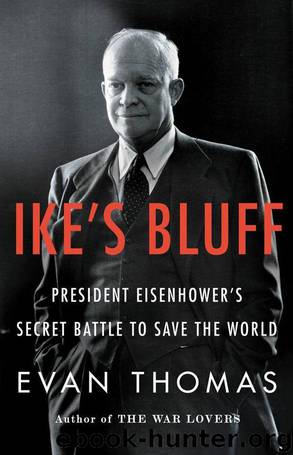
Author:Thomas, Evan [Thomas, Evan]
Language: eng
Format: epub, mobi
ISBN: 9780316217279
Publisher: Little, Brown and Company
Published: 2012-09-25T07:00:00+00:00
Like Eisenhower, Nikita Khrushchev felt comfortable around scientists. Awarded an engineering degree from the Stalin Industrial Academy, he was “very creative and curious” about technology, according to his son Sergei.21 Khrushchev was inordinately proud to be the first to suggest that missiles could be safely launched from silos (the designers worried they would burn up; Khrushchev correctly suggested lining the silos with steel to dissipate the heat). An all-purpose engineer, he also took an interest in building shelter for the masses. In the 1950s, Russia still suffered from a severe postwar housing shortage. At Khrushchev’s instigation, a hundred million people were housed in standardized five-story apartment houses stamped out by assembly lines. People were grateful—until the floors sagged, the roofs leaked, and the plumbing gave out. The apartment houses were called khrushchobi, which combined Khrushchev’s name and the Russian word trushchobi, for “slums.”
Khrushchev was the ruler of a poor, weak country, and he was fearful the Americans would find out. Russia’s muddy collectivized farms were barely producing enough food to feed the people. The Russians would periodically jam radio broadcasts from the West, but Russian musicians began making crude records of American rock ’n’ roll songs, dressing in jeans, and calling themselves bitniki. (Teenagers bid each other “See ya later, alligator,” after the Bill Haley and the Comets lyrics they heard over Voice of America.)22 Other intrusions from the West were more disturbing to Khrushchev. In March of 1956, the Strategic Air Command’s Curtis LeMay launched Operation Home Run, sending squadrons of bombers, their undersides painted white to deflect the heat from a nuclear blast, several hundred miles into Siberia just for practice.23 Then, beginning in June 1956 and continuing off and on, there were those mysterious high-altitude flights of some kind of American spy plane, still out of range of Soviet air defenses.
Khrushchev’s power had been threatened with an attempted coup in June 1957. The party secretary was rescued by Marshal Zhukov, Eisenhower’s old World War II comrade, who rallied to Khrushchev, flying loyal members of the party’s Central Committee to Moscow on a long-range bomber.24 As things worked in the Soviet hierarchy, by October Khrushchev had sidelined Zhukov, who was becoming a little too popular, and finally secured his place as solitary ruler of the Soviet Union. But he needed a way to show his people and the world that he was not afraid of the West.
The answer lay on a launching pad in the desert wastes of Kazakhstan. The place had no name and showed up on no map, though it would become known to Western intelligence as Tyuratam. Trees did not grow there. Temperatures in winter plunged to 35 degrees below zero and in summer soared to 135. On buried railroad trestles sat an odd, tulip-shaped set of metal claws. Into them, on October 4, 1957, was hoisted a massive, slightly hourglass-shaped rocket with four giant boosters. It was called the R-7, and it would become the hope and pride of the Soviet Union as well as the big stick of Nikita Khrushchev.
Download
Ike's Bluff: President Eisenhower's Secret Battle to Save the World by Thomas Evan.mobi
This site does not store any files on its server. We only index and link to content provided by other sites. Please contact the content providers to delete copyright contents if any and email us, we'll remove relevant links or contents immediately.
| U.K. Prime Ministers | U.S. Presidents |
Waking Up in Heaven: A True Story of Brokenness, Heaven, and Life Again by McVea Crystal & Tresniowski Alex(37815)
Empire of the Sikhs by Patwant Singh(23090)
We're Going to Need More Wine by Gabrielle Union(19055)
Hans Sturm: A Soldier's Odyssey on the Eastern Front by Gordon Williamson(18596)
Leonardo da Vinci by Walter Isaacson(13342)
The Radium Girls by Kate Moore(12036)
Tools of Titans by Timothy Ferriss(8403)
Educated by Tara Westover(8061)
How to Be a Bawse: A Guide to Conquering Life by Lilly Singh(7495)
Permanent Record by Edward Snowden(5852)
The Last Black Unicorn by Tiffany Haddish(5643)
The Rise and Fall of Senator Joe McCarthy by James Cross Giblin(5284)
Promise Me, Dad by Joe Biden(5157)
The Wind in My Hair by Masih Alinejad(5104)
A Higher Loyalty: Truth, Lies, and Leadership by James Comey(4967)
The Crown by Robert Lacey(4821)
The Iron Duke by The Iron Duke(4367)
Joan of Arc by Mary Gordon(4119)
Stalin by Stephen Kotkin(3973)
